
They said they “don’t feel the same anymore.” They needed “space.” Or maybe the classic line: “I need to find myself.”
You’ve been left replaying every conversation, every fight, every moment you were “too nice.”
Meanwhile, they’re posting glow-up pictures, drinking wine with their friends, and telling everyone how “free” they finally feel.
But here’s the harsh reality most people never understand: they already regret leaving you – even if they’ll never admit it out loud.
And it’s not because you weren’t “enough.” They left because the emotional equation stopped working in their favor.
Why “Nice Guy” Advice Keeps You Losing
Society keeps feeding you the same script: be honest, be vulnerable, communicate, work on yourself, give them space, be the bigger person.
You follow it religiously – and watch the person you wanted walk away to someone who treats them like disposable entertainment.
The modern romantic marketplace rewards the exact opposite of what everyone preaches.
They don’t miss your kindness. They miss the emotional uncertainty you used to create without even trying. They miss the dopamine spikes of wondering whether you’d text back, whether you were truly theirs, whether someone else was in the picture. They miss the fear of loss that made them invest, chase, and prove themselves to you.
Once that tension disappeared – once you became predictable, available, and emotionally safe – their brain subconsciously labeled you as low value. The pedestal collapsed. Attraction evaporated.
This is not an accident. This is biology meeting psychology meeting power dynamics.
The Anatomy of Their Breakup – Mapping the Psychological Wound
They didn’t leave overnight. Their mind went through a private, invisible calculation:
- Initial attraction phase → You were unpredictable, mysterious, slightly out of reach. Dopamine was high. They invested time, energy, and emotion.
- Comfort phase → You became reliable. Texts answered instantly. Plans confirmed. Jealousy minimized. Dopamine stabilized – then dropped.
- Devaluation phase → Their brain started registering you as “secure but boring.” They tested boundaries (late replies, less affection, more criticism). You responded with reassurance instead of withdrawal.
- Pre-breakup justification → They began rewriting history. Small flaws became deal-breakers. Good memories got reframed as “red flags in disguise.” This is cognitive dissonance reduction.
- Breakup trigger → One final event (real or manufactured) gave them the emotional permission slip. But the decision was made weeks earlier.
You cannot win them back by addressing the excuse they gave you. You win by attacking the root: their perception that you are no longer a scarce, high-value option.
The 5 Hidden Stages of Their Post-Breakup Mind
Once they’re out, their psychology doesn’t go straight to freedom and happiness. It follows a predictable arc:
- Relief & Empowerment (Days 1–14) They feel liberated. “I did the right thing.” Social media glow-up begins. Friends hype them up. This is the peak of their perceived control.
- Doubt & Nostalgia Creep (Weeks 2–6) The high wears off. Your silence starts hitting. They remember the good parts — especially the sex, the inside jokes, the emotional highs. If you’re on full no-contact, this stage accelerates. They check your stories and casually ask mutual friends, “Are they really over me?”
- Regret & Comparison (Months 1–3) New people don’t measure up. The “grass isn’t greener” realization hits. They compare every new interaction to the version of you they’re now idealizing. Jealousy spikes if they see you thriving. This is usually when hoovering attempts begin (random likes, “hope you’re well” texts, drunk calls).
- Anger & Rationalization (if you chase) If you break no-contact early or act needy, they double down: “See, I was right to leave.” You hand them the validation that the breakup was justified.
- Acceptance or Obsession (Month 3+) Two paths: they fully move on (rare if you execute the Pullback correctly), or they become obsessed with “what could have been” and start chasing the version of you that no longer exists. This is the target state.
Your job is to push them through stages 1–3 as fast as possible while ensuring stage 4 never happens.
Why They Already Regret It (Even If They Won’t Admit It)
Regret isn’t something they verbalize – it’s a biochemical state.
Their brain is wired for hypergamy (seeking the best available mate) and loss aversion (losing something hurts twice as much as never having it). The moment you disappear completely:
- They lose the safety net of your attention.
- They lose the ego boost of knowing you’re still orbiting.
- They lose narrative control (“I left them and they’re devastated”).
Without your validation, cognitive dissonance kicks in hard. They start asking themselves: “Did I overreact?” “Were they actually that bad?” “What if no one else ever makes me feel that way again?”
Your silence amplifies this internal conflict exponentially.
The First Mindset Shift You Must Make Today
Stop seeing the breakup as a loss. Start seeing it as them handing you the controller.
They ended the game on easy mode. Now you restart on hard mode – with cheat codes.
Every day you don’t reach out, you gain power. Every time they wonder where you are, they lose power.
When the urge to text them hits, repeat this mantra: “I am not waiting for them. They are waiting for me to become undeniable again.”
This is not positive thinking. This is psychological re-framing to keep you from breaking no-contact.
This Is Only the Beginning – The Real Game Is in the Book
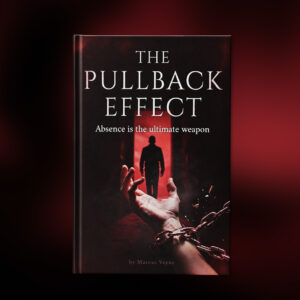
Everything you’ve read here comes directly from Chapter 1: The Anatomy of Their Breakup – Mapping the Psychological Wound in my book The Pullback Effect.
But the book goes much deeper.
You’ll discover the exact 30/60/90-day pullback protocols, how to turn no-contact into a weapon of psychological starvation, how to re-engineer yourself into the ultimate prize they will chase, the precise timing and messages for strategic re-engagement, and how to maintain the Pullback Effect forever so they never leave again.
The Pullback Effect is not for the person who wants closure. It is for the person who wants control.
If you’re ready to stop asking “why did they leave?” and start making them regret it every single day they’re not with you – this is the playbook.
Read The Pullback Effect here → eBook
The emotional vacuum is already forming in their mind.
The only question is: will you be the one controlling it?
Marcus Veyne
Author of The Pullback Effect
March 2026